
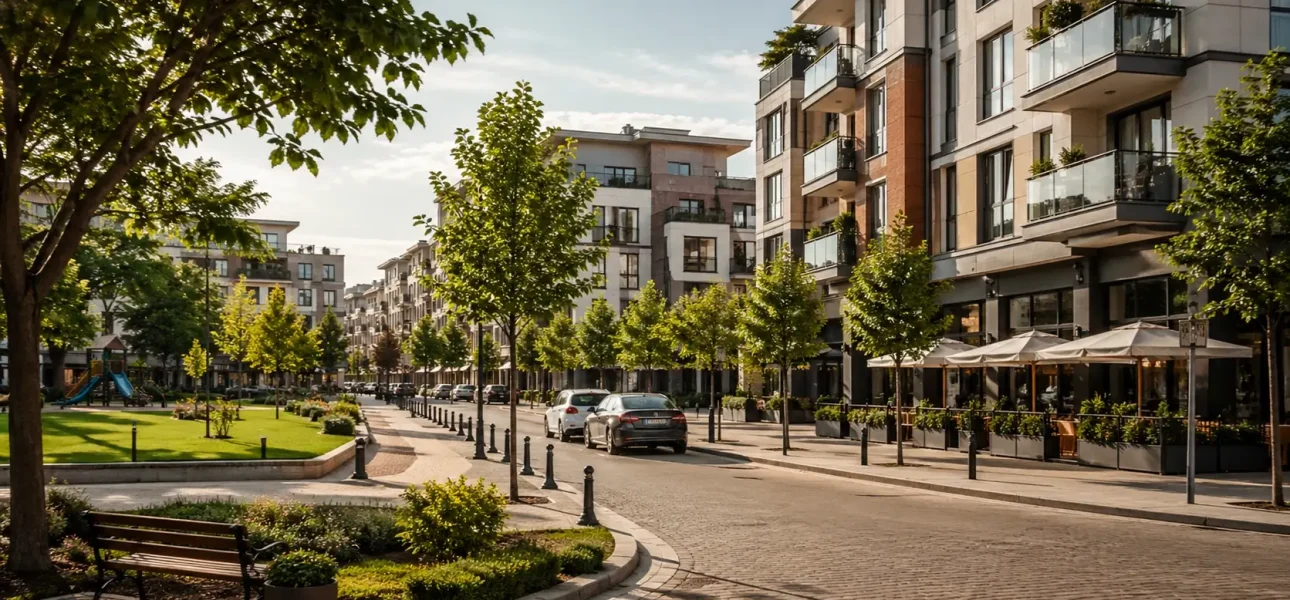
We all want to live in a home that feels both central and peaceful. In fact, that is a basic and natural expectation.
A solid building, complete sound insulation, and strong thermal insulation are of course among our top priorities.
But if the location choice is not made correctly, we cannot fully benefit from these essential qualities.
So let’s look at why location matters, and what choices you should make when buying a home or renting a new one.
The Right Location Improves Quality of Life
When evaluating a home, we often focus on factors like the number of rooms, square meters, or interior design.
But what truly makes a home valuable is its surrounding environment. Because what you are buying is not only four walls, it is a life that will take shape inside those walls.
The street you see when you leave in the morning, the sense of safety you feel when you return in the evening, the park where you walk on weekends, the school your child attends.
All of these are part of location.
Location sets the rhythm of daily life. Your routines, your social circle, how you use your time, and even your mood are strongly connected to where you live.
That is why choosing a home is also choosing a lifestyle.
When the right location is selected, a home stops being only a shelter and becomes a center that makes life easier, supports you, and adds value to your days.
Transportation and Time Management
In modern city life, time is one of the most valuable resources. That is why a home’s transportation options directly shape quality of life.
Easy access to work, school, and social areas reduces the daily burden.
A life spent for long hours in traffic creates both physical and mental fatigue over time.
Being close to public transport lines such as metro, metrobüs, or tram, or having easy access to main roads, provides not only comfort but also flexibility.
Having alternative routes and options makes life easier when unexpected situations happen.
Strong transportation access also helps a neighborhood protect and increase its value, because people consistently prefer what is easy to reach.
Another dimension of transportation is consistency.
It is not only distance that matters, it is how long that distance takes and under which conditions.
That is why you should think beyond the map and consider the real day to day commuting experience.
Access to City Amenities
Another factor that makes a location valuable is access to the opportunities the city offers.
Hospitals, schools, shopping areas, sports facilities, and cultural venues are key elements that define how livable a neighborhood is.
Being close to these amenities makes daily life easier and improves overall quality of life.
For families with children, proximity to educational institutions matters a lot.
Fast access to healthcare is a major advantage for every age group.
Beyond that, being able to reach social and cultural spaces strengthens a person’s connection with the city.
Easy access to a concert hall, a library, or a park makes life not only practical but also meaningful.
Completely disconnecting from city life can look attractive at first, but in the long run it can lead to social isolation.
The goal is to maintain a connection with the city while still living well.
In this sense, choosing location is the ability to build that balance.
Balancing a Calm Life with City Living
Modern cities are built around density and movement. But within that intensity, the need for calm is felt more than ever.
A quieter environment where you can breathe is essential for both mental and physical health.
The goal is not to move far away from the city, but to find a calm lifestyle that remains compatible with it.
A location where you can wake up to birdsong, take an evening walk, and still reach the city center easily when needed forms the foundation of an ideal life.
Neighborhoods that can create this balance are valuable not only today but also in the future.
Because people are no longer only looking for a place to stay, they are looking for an environment where they can feel good.
Safety and Social Fabric
For a home to truly become a home, you need a sense of safety.
If you do not feel safe, even the most modern or most aesthetic building can feel incomplete.
That is why the safety profile of a neighborhood should always be considered when choosing location.
Safety is not limited to physical measures. It is also connected to social fabric.
Neighborhood culture, relationships with neighbors, and the general lifestyle in the area directly affect how safe you feel.
An environment where people recognize each other, greet each other, and support each other when needed is a strong contributor to quality of life.
Areas that protect cultural values, keep a connection with the past, and still align with modern life offer not only a living space but also a sense of belonging.
Over time, that belonging turns a property into a real home.
Earthquake Reality and Reliable Ground Conditions
In a country on an active seismic belt like Turkey, location choice is not only about comfort or access.
It is also a safety decision. That is why ground conditions, development patterns, and engineering standards in a region matter greatly.
Living in a solid building matters, but the reliability of the ground under that building is just as critical.
Areas with proper soil surveys and well planned development reduce risk.
You should also consider evacuation options, proximity to emergency gathering areas, and alternative routes.
In crisis moments, accessibility becomes a life saving factor.
That is why you should evaluate not only today, but also possible scenarios.
A safe living environment is only possible with this broader perspective.
Investment Value and a Future Perspective
A home is also a significant investment. How that investment gains value is strongly connected to location.
Development potential, new transportation projects, infrastructure investments, and changing population dynamics are signals of future value growth.
Areas that are not fully developed yet but have strong potential can offer major opportunities when the timing is right.
At the same time, established neighborhoods with proven value can provide a more stable and predictable investment path.
What matters here is defining your expectations clearly.
Knowing whether you want a safer, stable choice in the short term or higher long term return helps you choose the right location.
The Per Yapı Approach
For Per Yapı, location is far more than a project decision.
Because Per Yapı does not only build buildings, it builds trust, and it brings projects to life with that responsibility.
In its developments, it prioritizes reliable ground selection and correct settlement planning.
Its work in areas such as Üsküdar and Çengelköy, which carry Istanbul’s historic and cultural identity strongly, are concrete examples of this approach.
In Per Yapı’s perspective, modern architecture is not only an aesthetic choice.
It is also part of a safe, sustainable system that improves quality of life.
That is why it develops projects that fit the natural environment, respect the historic fabric, and remain connected to the city.
Locations are selected exactly with this mindset.
For this reason, projects that combine location advantages with strong build quality become a strong alternative for people who want both a good life and a smart investment.