
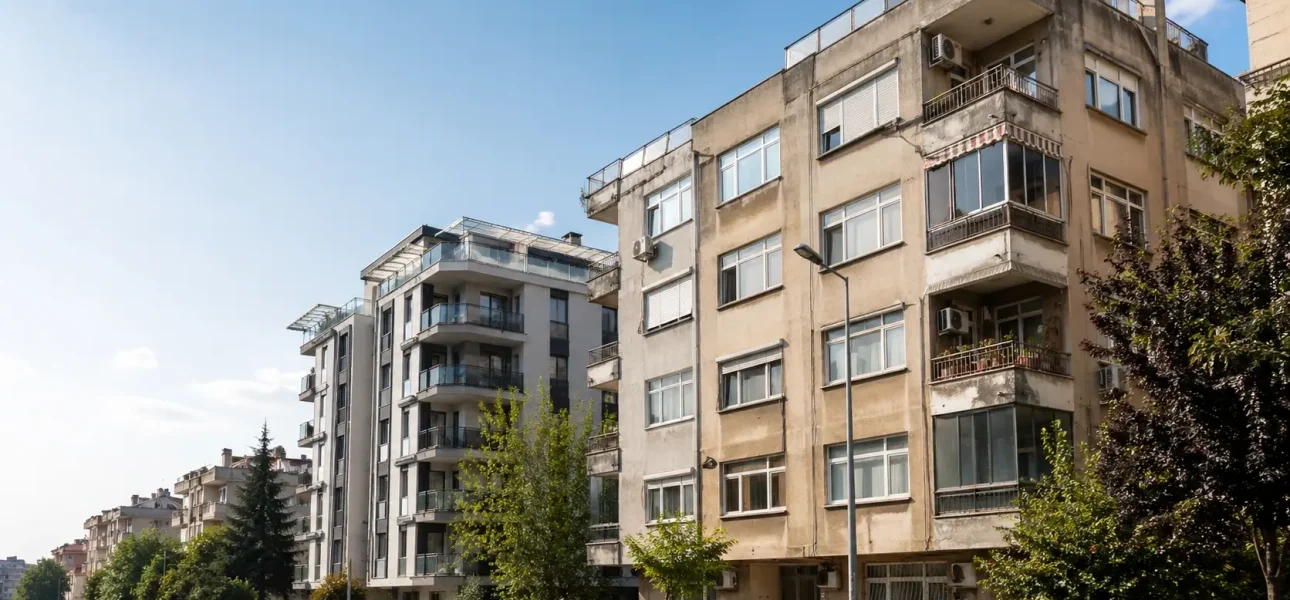
Why does building age matter when buying a home? Is there a critical age threshold for buildings? How much should we care about age when purchasing a property or renting a new home?
These questions are on many people’s minds. Because a home is not only a living space, it is also a serious investment in terms of safety, comfort, and the future.
That is why building age often becomes one of the first criteria people look at. But the real issue is not only how old it is, it is what that age actually means and how it should be evaluated together with other conditions.
How Can You Find Out a Building’s Age?
Building age refers to the time that has passed since a structure was built. The most reliable way to learn this is through official records.
Title deed records, construction permits, occupancy permits, and municipal archives provide the clearest information.
If these documents do not show a clear date, the building’s architectural characteristics, the materials used, and the surrounding development may provide an approximate idea.
Still, the key is not only to learn the age, but to interpret it correctly together with construction quality.
Why Does Building Age Matter?
Building age directly affects many factors, from safety and comfort to costs and investment value.
Older buildings often require more maintenance, their installations may be outdated, and they may fall behind current standards.
Newer buildings, on the other hand, usually offer more modern solutions.
But there is a critical point: being new does not always mean being safe.
That is why building age should not be a stand alone decision criterion. It should be part of a broader evaluation process.
Earthquake Reality and Building Age
In Turkey, the most critical factor when evaluating building age is earthquakes.
Earthquake regulations that came into force after 1999 significantly changed construction standards.
That is why there is a common perception that buildings constructed after 2000 are safer.
However, this is not always true. Compliance with regulations matters, but execution quality is just as decisive.
A newly built structure constructed with poor workmanship or low quality practices can be riskier than an older but well built building.
The earthquakes on February 6, 2023 centered in Kahramanmaraş are among the most striking examples of this.
The collapse of many buildings that could be considered “new” made it clear that building age alone does not guarantee safety.
This once again showed that structures must be evaluated not only by construction year, but also by soil studies, engineering quality, materials, and execution processes.
For this reason, you should ask: Was a soil survey conducted? Which regulations was the building designed under? Were inspection processes carried out properly?
Soil and Foundation Systems: Invisible but Decisive
Regardless of a building’s age, the most critical factor is the soil. No structure can be considered safe if soil characteristics have not been analyzed correctly.
Foundation systems matter a lot here. A raft foundation spreads loads across a wider area and helps balance earthquake effects.
Pile foundations, especially in weak soils, improve safety by anchoring the structure to stronger layers.
In addition, seismic isolators reduce interaction between the building and the ground, directly lowering earthquake forces.
Shear wall systems increase resistance to lateral loads and improve structural stability.
If a building is not supported by such engineering solutions, being new alone will not be an advantage.
Concrete Lifespan and Material Quality
The common statement “concrete lasts 50 years” is incomplete and misleading. Time alone does not determine concrete lifespan.
A reinforced concrete building that is designed correctly, built with quality materials, and maintained regularly can last much longer.
Today, safer buildings often use higher strength materials such as C40 class concrete and B420C reinforcing steel.
C30 and above concrete classes, fiber reinforced concretes, corrosion resistant reinforcement, and advanced formwork systems also support structural safety.
Modern engineering solutions such as carbon fiber strengthening (CFRP), steel bracing systems, and energy dissipation (damper) technologies can significantly improve earthquake performance.
On the other hand, low quality concrete, insufficient reinforcement, and faulty workmanship can make even the newest building risky in a short time.
Old Buildings and Urban Renewal
Urban renewal is a major topic especially for buildings constructed before 2000.
These structures are often not aligned with current earthquake regulations and may require strengthening or rebuilding.
But there is an important point in the renewal process: demolishing and rebuilding is not enough.
The new building must truly be constructed with correct engineering principles, proper soil analysis, and quality materials.
Otherwise, you can end up with “new” buildings that carry the same risks.
The Real Difference Between New and Old Buildings
New buildings generally offer better insulation, more modern installation systems, and more functional interiors.
Older buildings more commonly suffer from heat loss, insufficient insulation, and higher maintenance needs.
Still, this difference is not absolute. A well maintained or properly renovated older building can compete with newer ones in comfort and durability.
Instead of saying “new is better,” the better question is “which building was built correctly?”
The Surrounding Area Matters Too
A building may be new, but if surrounding buildings are old and weak, that can create serious risk.
During an earthquake, the collapse of nearby buildings can endanger newer structures as well.
That is why you should evaluate not only the apartment, but also the street, neighborhood, and overall building quality in the area.
A safe living environment is not only about one building.
Building Age and Property Value
Building age directly affects a property’s sale price and rental income. Newer buildings are usually priced higher and attract more demand.
However, an older building in a good location that is solid and well maintained can also preserve its value.
So when investing, you should look beyond age and evaluate location, access, neighborhood amenities, and construction quality together.
Conclusion: Age Matters, but It Is Not Enough on Its Own
Building age is an important indicator, but it is not the only deciding factor.
To understand whether a structure is truly safe, you must evaluate age together with soil conditions, materials, construction technique, maintenance status, and environmental factors.
In a country living with earthquake reality, each of these factors can be critical.
A new building can be safe, but only if it was built correctly.
An older building can be risky, but with proper maintenance and strengthening, it can become safe.