
We all want our building to be safe. And when you remember that we live in an earthquake country, this desire becomes less of a preference and more of a necessity.
The geography we live in turns structural safety from a purely technical topic into something directly connected to life itself.
It is important to remember that building safety is not limited to earthquakes. Earthquakes are one of the most critical factors, but they are not the only one.
For a structure to be truly considered safe, its fire resistance, long term performance, maintenance needs, material quality, adaptation to climate conditions,
and how it behaves over time must also be evaluated together.
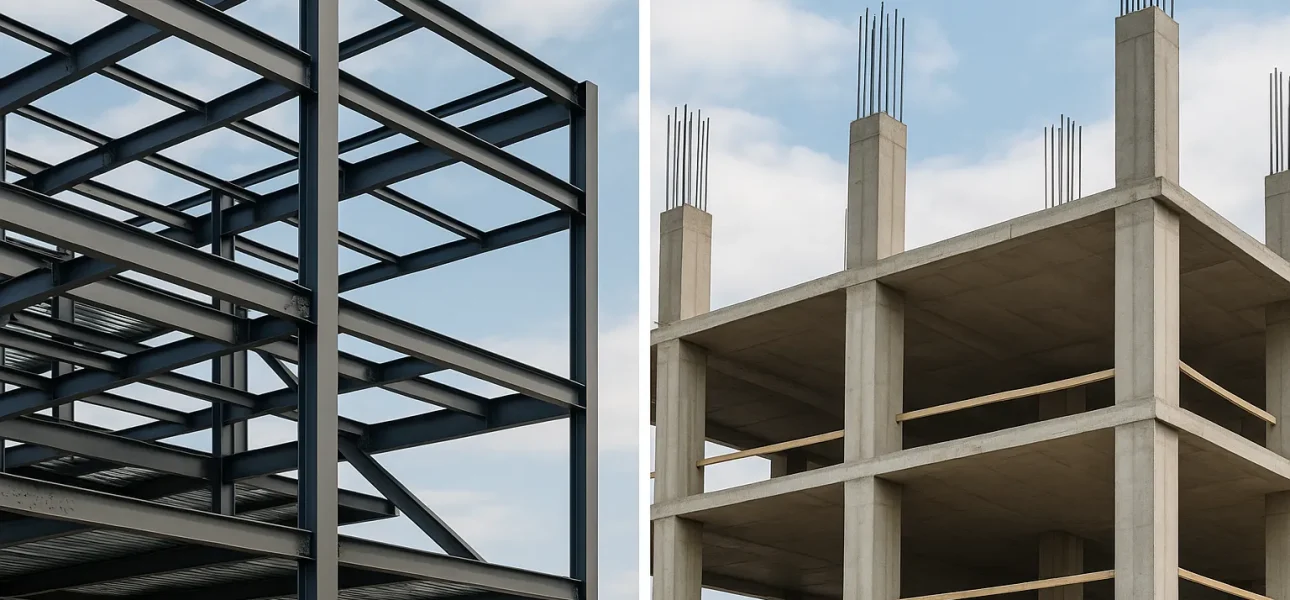
Today, two main structural systems stand out in residential construction: reinforced concrete and steel structures.
Both are widely used, and both have strong sides and limitations. That is why the question “which is safer?” only makes sense when we look at the pros and cons together.
Reinforced Concrete: Traditional Strength, but Correct Execution Is Essential
Reinforced concrete is a system that combines concrete’s strength in compression with steel’s strength in tension.
The fact that it is the most common building type in Turkey shows that this system has a long standing tradition of practice.
One of the strongest sides of reinforced concrete is its rigid behavior. When designed correctly, it has high load carrying capacity
and can preserve its structural integrity for many years. Concrete also provides natural fire resistance, which is another advantage.
However, the safety of reinforced concrete buildings depends heavily on execution quality. Concrete is cast on site, and every stage is exposed to human error.
Formwork mistakes, incorrect rebar placement, low quality concrete, insufficient vibration, or improper curing can weaken a structure from the very beginning.
Another important point is that reinforced concrete is a heavy system. The heavier a structure is, the more load it transfers to the ground,
and the larger the forces generated during an earthquake. When evaluated together with soil conditions, this can create serious risks.
Also, concrete is not a single uniform material. Its strength can vary depending on the type of cement used, aggregate quality, water cement ratio,
and chemical additives. Even using different concrete grades within the same project can negatively affect the building’s overall performance.
Another issue that can develop over time is rebar corrosion. Moisture and air that penetrate the concrete can cause steel to rust.
This weakens the structural system and can lead to damage that is difficult and costly to repair.
Steel Structures: Lightness, Ductility, and the Advantage of Control
Steel structures are one of the most important building systems modern engineering offers. The structural frame is made of steel profiles,
and despite their high strength, these profiles are relatively lightweight.
Steel’s most distinctive advantage is its ductility. In other words, it deforms under load before it fractures.
This is critical not only during earthquakes, but also for overall structural safety. It reduces the risk of sudden collapse
and makes the building’s behavior more predictable.
Because steel buildings are lighter, they reduce the load on the ground. This is an advantage for foundation design
and also lowers long term settlement and deformation risks.
Another major advantage is the production process. Steel components are largely manufactured in factory conditions,
which allows better quality control. As on site work decreases, the risk of mistakes drops. Construction time is also shorter.
From an architectural perspective, steel structures offer more flexible solutions.
Larger spans, column free spaces, and modern designs can be implemented more easily with steel.
That said, steel structures also have points that require attention. The most important is fire exposure.
Steel can lose its strength rapidly at high temperatures. For that reason, fire insulation and protective coatings must be applied correctly.
Another key issue is corrosion. Steel can rust if it is not protected properly.
Galvanizing, paint systems, and regular maintenance are essential. If maintenance is neglected, safety can decrease over time.
Safety Is Not Limited to Earthquakes
Building safety is often seen as the same thing as earthquake resistance. In reality, true safety is a much broader concept.
For a structure to be considered safe, it should:
- Be resistant to fire
- Maintain its load bearing capacity over many years
- Adapt to climate conditions
- Be protected against moisture, water, and corrosion effects
- Allow proper maintenance and repair
These criteria must be evaluated together. From this perspective, neither reinforced concrete nor steel is “absolutely safe” on its own.
Safety is less about the system itself and more about the quality of design and execution.
The Real Determinant: How It Is Built
The question “reinforced concrete or steel?” is often asked from the wrong angle.
The real question should be: Was this building designed correctly, built with the right materials, and inspected properly?
Because:
- A well designed reinforced concrete building is safe.
- A poorly executed steel building is risky.
- No system lasts long without quality materials.
- Any building constructed without proper inspection carries potential danger.
Building safety is not a material problem. It is a process management problem.
A Safe Building Is the Result of a Conscious Approach and Proper Execution
There is no single definitive answer to the question of reinforced concrete versus steel.
Because safety does not come from material alone, it comes from engineering, execution, and responsibility.
A structure that is designed correctly, built with quality materials, and inspected regularly can be safe whether it is reinforced concrete or steel.
A structure that is designed poorly or executed carelessly is risky regardless of the system used.
In the end, a safe building is not a preference. It is the outcome of a conscious approach and proper execution.